Celebrate Black History Month
February is Black History Month. Year-round, there are opportunities to highlight Black voices, challenge anti-Black racism and strengthen our communities through allyship. This month is a time to be intentional in celebrating and recognizing Black contributions both past and present.
Black History Month was officially recognized in Canada in December 1995 following a motion introduced by the Honourable Jean Augustine, the first Black Canadian women elected to Parliament.
People of African and Caribbean descent, who have been a part of shaping Canada’s heritage and identity since the arrival of Mathieu Da Costa, a navigator and interpreter, whose presence in Canada dates back to the early 1600s. Few Canadians are aware of the fact that African people were once enslaved in the territory that is now Canada, or of how those who fought enslavement helped to lay the foundation of Canada’s diverse society.
Black people in Canada continue to shape history and culture at every level. Black History Month is an opportunity to celebrate Black history today and every day.
Ways to Engage
Black Care Baskets
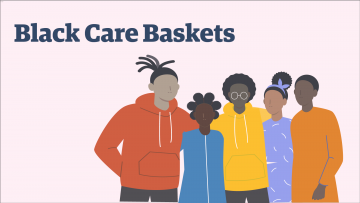
Black Care Baskets are a Black History Month initiative created by the Equity and Inclusion Office in collaboration with the Global Engagement Office and the African Caribbean Student Club.
Students, faculty and staff who identify as Black/African/Caribbean are invited to sign up for a Black Care Basket. This year, baskets contain self-care products such as coffee, tea, chocolate, soap and more.
Thank you for registering! All 50 of the Black Care Baskets have been claimed. You can participate in other Black History Month initiatives here. For questions, please contact equity.ubco@ubc.ca.

Thank you to the Provost Office, Athletics and Recreation, Sexual Violence Prevention & Response Office, Student Experience Office and the UBC Students Union Okanagan for supporting this initiative.
Thank you to Abantu Beauty Products, Hatch Coffee Roasters, Karat Chocolate, Okanagan Lifestyle, Karibu Soaps, Bright Jenny Coffee, Okanagan Select and House of Caribbean.
Healing and Understanding Syilx Plantlife
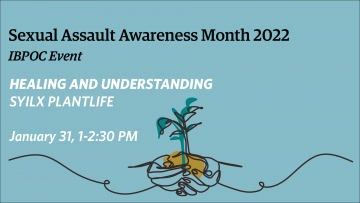
Join Syilx facilitator, Krystal Withakay, to learn about Syilx plantlife and build a deeper understanding of the connection between land and healing. This event is free and part of Sexual Assault Awareness Month, sponsored by UBC’s Sexual Violence Prevention and Response Office. Open to all IBPOC staff, faculty and students.
REGISTER HERE:
International Human Rights Day
On December 10, we’re celebrating International Human Rights Day. This year, we’re reflecting on equality and equity. UBC Human Rights Advisors Oluwaseun Ajaja and Libby Zeleke, and UBC Inclusion Action Plan Coordinator Okong’o Kinyanjui lead us in discussions on human rights, their trajectories, and share their favourite resources.
Learn about your rights
BC’s Human Rights Grounds
The BC Human Rights Code protects 14 grounds of discrimination. Everyone has the right to be free of discrimination based on:
- age (actual or perceived)
- ancestry
- colour
- family status
- marital status
- physical or mental disability
- place of origin
- political belief
- race
- religion
- sex
- sexual orientation
- gender identity or expression
- criminal conviction unrelated to employment
Human Rights at UBC
UBC Policy #SC7 on Discrimination & Harassment highlights UBC’s commitment to creating a study and work environment that is free from discrimination on those grounds protected by the BC Human Rights Code. The Policy provides procedures for making complaints, responding to complaints (up to and including formal investigation), and remedies to address instances of discrimination.
UBC Vancouver Anti-Racism Human Rights Advisor Oluwaseun Ajaja shares more information on human rights at UBC, as well as his guiding philosophies. UBC Okanagan Human Rights Advisor and Respondent Support Advisor Libby Zeleke discusses her role and shares her favourite resources, and Inclusion Action Plan (IAP) Coordinator Okong’o Kinyanjui talks about the experiences that lead him to UBC, and how he stands up for equality and equity wherever he goes.
Human Rights Day: Get to Know UBC Vancouver’s Anti-Racism Human Rights Advisor
For international Human Rights Day on December 10th, Oluwaseun Ajaja explains his role at UBC and shares his favourite resources.
Can you talk a little bit about the work that you do?
I sit within the human rights team at the Equity & Inclusion Office. We hold space, provide support for, and advise UBC community members on issues of discrimination, harassment, and other human rights concerns they might have. Policy SC 7 – UBC’s Discrimination Policy – is the primary document that guides our work. And the policy itself is based on the B.C. Human Rights Code. As such, its scope is narrower than that of the Code. Within the Human Rights team, my role focuses on race-based complaints with their unique nuances that are often not easily understood and, as such, usually fall through the cracks.
Nipping in the bud, supporting, and advising UBC community members in a way that centers these concerns is my primary responsibility. Of course, success here requires collaborating with the various units, departments, and faculties on campus. In all, I see my role at UBC as one that loosely supports UBC community members as they live, learn, conduct research, associate amongst one another in a way that dignifies their differences and celebrates their sense of belonging irrespective of their race or other expressions of identity. My colleagues and I also try to ensure that those who approach our office for support leave feeling a little better and dignified than when they walked in.
What contributed to your desire to do this work?
I grew up under a brutal military dictatorship. The acute sense of restricted freedom I felt growing up instilled in me the importance of freedom, particularly what my mother refers to as responsible freedom. In my early teens, I was introduced to and gradually began to understand that responsible freedom would remain unachievable without sensible advocacy.
At the same time, I also realized that the responsibility for making and pushing for things to be better could neither continue to be futuristic nor left for others. Instead, it is a shared responsibility underpinned by a sense of urgency – both of which continue to guide my work.
The push for responsible freedom and sensible advocacy sums up human rights advising. And sufficient understanding and expertise in both are integral to human rights advising. So, the quest to ensure that freedom is reasonably pursued and advocacy is sensibly expressed, especially for those who neither have the voice nor freedom, led me to and remain the push for continuing in this work.
What philosophies have shaped your perspective?
Awareness, understanding with compassion, and participation are the three philosophies that shape my perspectives. I believe that the simpler the philosophies are, the easier it is to live up to them.
Awareness is self-explanatory. You can never know too much. Even on issues where you perceive yourself as an expert, changes show up in ways you least expect, exposing the frontiers of your ignorance. Constant awareness makes you teachable, and continuous learning is the best defense against ignorance and the consequential harm that results.
Similarly, being aware is usually not enough. Human rights advising is broad, fluid and inherently difficult. Usually, the concerns that people raise are simultaneously steeped in a painful past, a challenging present, and a hopeful future. Navigating these require a sense of compassionate understanding. This is the best way to build trust. And I can overemphasize the importance of trust in this work. Once you lose the trust of the parties, this job that is inherently difficult immediately becomes almost impossible.
The third is participation. Human rights advising is a collective job. Success usually requires collaboration from the victims and alleged perpetrators. Collective participation matters even when the issue being discussed seems simple. Human rights issues are never simple. They are usually multilayered. Collaborative participation is one way to ensure that people would continue to exercise their freedom reasonably even when the avenue to exploit others becomes available.
What are some books on human rights that you recommend?
That’s a tough one. How do I pick? I guess I’ll focus on recently published books then. The first is Re-Imagining Human Rights by Williams R O’Neill. O’Neill challenges the philosophy of Jeremy Bentham, who said that the concept of naturally occurring rights is nothing but nonsense on stilts. This book re-argues that rights are neither created out of thin air nor indeed bestowed by the government. Instead, codified rights are simply natural rights that society – for a plethora of reasons – have denied groups of people, either based on their race, gender, sexual orientation etc. Thus, in the loose sense, human rights are nothing more than exerting deliberate acts to remove the artificial constraints to the full realization of these naturally occurring rights. Once you understand this, you will begin to rethink the notion of human rights as attempts to actualize what already exists rather than the creation of new concepts of rights.
The second book I will recommend is The Debasement of Human Rights by Aaron Rhodes. This book is best succinctly summarized by the words Benjamin Franklin when he noted that “those who would give up essential liberty, to purchase a little temporary safety, deserve neither liberty nor safety.” This book traces how human rights have been so debased for the yet to be realized promises of an egalitarian economic prosperity, political equality, and other false notions of equitable safety. The effect is that we have lost on all fronts, with members of marginalized communities bearing the more significant brunt.
The third book I will recommend is appropriately titled Rescuing Human Rights by Hurst Hannum. I think the title is self-explanatory.
What advice do you have for people in the UBC community?
Human rights — which are simultaneously broad and restrictive — are essential to a thriving UBC. Like I said at the beginning of this interview, the responsibility of ensuring that UBC becomes a place where our differences are celebrated and our diverse identities appreciated is collective. It could be as simple as being teachable about our blind spots on human rights issues or a willingness to engage with others outside our comfort zone with compassionate understanding.
This year’s United Nations Human Rights Day theme is around Equality. Can you reflect a bit on what this theme means to you at a personal or collective level?
I am not surprised by this theme because it is where we are or at least aspire to be. At the local level, it could be as simple as attempting to answer the question “what happened to you” when human rights concerns are raised. It could also mean providing support and resources based on the level of need of an individual within a local context rather than as a collective. The collective is where it gets interesting because it is about drastically reducing the artificial barriers to access. And I use the term ‘artificial barriers’ deliberately because most of the constraints on human rights are a mirage — but a mirage sustained by institutions of colonization and exploited by the powerful in hopes of maintaining the status quo.
Human Rights Day: Get to Know UBC’s Inclusion Action Plan Coordinator
For International Human Rights Day on December 10th, Okong’o Kinyanjui, Inclusion Action Plan (IAP) Coordinator at UBC Vancouver reflects on his trajectory, equity and equality.
Can you talk a bit about the work you do?
My role as the IAP Coordinator is to support Action Planning Teams (APTs) with administrative and communication support. This includes scheduling meetings as well as developing and circulating agendas, materials, and minutes. I also support communication across and within APTS and also support them in setting up end-user consultations. Action Planning Teams are responsible for developing work plans to realize the 12 prioritized IAP actions that require implementation at the institutional level.
What made you decide to do this kind of work?
Growing up in Kenya, I lived in constant fear of being outed and imprisoned under Kenya’s colonial 14-year imprisonment penalty. This prejudiced colonial penal code has prevented us as queer people from mobilizing for our rights, sharing resources in times of need, and building meaningful connections with each other. This situation drove me into what I term life-threatening isolation, but virtual networks saved and sustained me until I could find acceptance in my immediate environment.
This led me to co-found the Queer African Network (QAN). We ensure that every queer person in Africa, and its diaspora, have access to fulfilling social connections and the resources to self-actualize.
While I was a student, I received a full academic scholarship to study at Quest University Canada, which is where I served on the Equity Diversity Committee, as well as the elected Human Rights Minister and, later, as President of the Quest University Students’ Association.
It’s really interesting to come from a context like Kenya where you can literally be imprisoned for your sexuality, to working in a university in more rural B.C., to now being at UBC. Across all the work I’ve done, it’s been critical to have solid knowledge on JEDI.
What has shaped your philosophy around human rights?
I first encountered Ali Bhagat in an undergraduate course. Ali Bhagat’s research challenges the notion of Cape Town as a safe haven for queer migrants by looking at how race, class, and migration/legal status intersect to disproportionately marginalize black queer African migrants. His work does a great job of highlighting how the city scape (and the inadequate distribution of access to safety) is by design.
Often, queerness in Africa is only talked about from the legal or the Sexual Reproductive Health Rights (SRHR) lens, but S.N. Nyeck’s body of work examines the queer lived experience on the continent. For S.N. Nyeck, “queerying” is a critical praxis and the first step to understanding how innovation emerges from the margins and quotidian life.
Stella Nyanzi is another scholar who researches a lot about queer experiences in Africa, and especially in an educational context. She talks about radical rudeness and writes these really rude poems where respectability politics go out the window. She helped me understand that when your rights and freedoms are threatened, it is no use to be self-silencing in favour of appearing respectful.
What are some films you recommend?
Kenya’s first queer film, Stories of Our Lives, was made by someone I know, and them and their team were thrown in prison for this. It was the first time I saw a queer film by and for Africans when I was a teenager and it completely moved me.
Call me Kuchu follows David Kato, a queer activist in Uganda, who was unfortunately murdered before the film came out. Kuchu is a slur — it’s like the equivalent of queer before it was reclaimed.
I am Samuel is a powerful film that just came out this year, and the Kenyan government banned it. When it was released, we worked with our community in Kenya to organize secret screenings in opposition to the ban.
This year’s United Nation Human Rights Day theme is around Equality. Can you reflect a bit on what this theme means to you?
Queer African migrants and asylum seekers don’t really have equal opportunities to succeed and to self-actualize. Even within the process of seeking asylum, migrants not only face prejudice from immigration officials but from other migrants as well. Turning to UBC and Canadian higher education institutions more broadly, I’d also say that there’s a certain way that international students and staff can be perceived. Specifically, international students are often thought of as wealthier individuals who can afford to be here, and rarely as individuals who aren’t allowed to be themselves in their own communities.